
In 2023, I wrote an article breaking down the financial mechanics of Charge Point Operators. The conclusion was sobering: No CPO was profitable, and the math to get there required a combination of great locations, long contracts, cost-efficient construction, and lean operations — with the added caveat that even doing everything right might not save you from market saturation driven by irrational competitors.
Two and a half years later, nothing fundamental has changed about CPO profitability. But a lot has changed about who owns these networks, and why. The consolidation game is now well underway, and it's starting to reveal who the long-term winners might be.
This article is about the reshuffling of the European CPO landscape. Who's selling, who's buying, and what kind of companies will be operating Europe's charging infrastructure in 2030?
Table of Contents
- The original sin: Why most CPOs exist
- Peak Fuel: The clock is ticking for fuel retailers
- The transaction table: Who's been buying and selling?
- Who is likely to sell, and why
- Who is likely to buy, and why
- The property owner advantage — and the oil major paradox
- What about CPO-as-a-Service?
- The consolidation timeline
- When does CPO profitability arrive?
- Who are the long-term players?
- The bottom line
- Appendix: Oil major retail divestments in detail
The original sin: Why most CPOs exist
To understand the consolidation game, you need to understand why all these CPOs were created in the first place. In my own mental model, there are roughly seven types of CPOs, each with a different strategic rationale for being in the game. Let me give you the quick version.
The Utility
(such as EnBW, Statkraft / Mer, eON, Allego, Fortum) saw synergies between charging and their energy business. Charging was an asset play that also ticked ESG boxes. The problem: Volatile energy markets and back-to-core strategies have severely limited their appetite for asset-heavy, loss-making side bets.
The OEM
(such as Tesla, NIO, IONITY) wanted to sell more cars, create a premium charging experience, and build brand loyalty. Charging was a cost center justified by synergies. Except for Tesla, which built something genuinely unique, most OEM networks have struggled to find a defensible position.
The Oil Major
(such as BP, Shell, TotalEnergies) had massive free cash flow and wanted to tick ESG boxes while learning the energy transition. When I first built my CPO typology, the oil majors seemed like the strongest structural players in the game. They owned their petrol stations outright or on long leases — which I argued was the most important asset in the whole game. But since 2022, the oil majors have done something I didn't fully anticipate: They started selling the property. BP is systematically exiting company-owned retail across Europe. TotalEnergies sold its German and Dutch networks to Couche-Tard and formed a JV for Belgium and Luxembourg. Shell is consolidating rather than expanding. The detailed breakdown is in the appendix, but the upshot is this: thousands of attractively located European petrol stations are flowing from oil companies to dedicated fuel retailers (Couche-Tard/Circle K, Catom/OK), infrastructure funds, and local operators.
It's also worth noting who is not divesting: The national oil companies and European national champions. Repsol, Galp, PKN Orlen, and ENI — vertically integrated players who combine upstream production, refining, and company-owned retail — may end up being the oil-sector participants who actually execute the petrol-to-charging transition, precisely because they haven't separated their retail from their upstream business.
The Retailer
(such as McDonald's, Lidl, Leclerc, Tesco) controls attractive property and sees charging as a way to drive foot traffic. While these players have traditionally outsourced charging, they could easily decide that they don't need a CPO middleman.
The Fuel Retailer
(such as Circle K, Tank & Rast, OKQ8, Aral) controls central highway locations but has, with a few honorable exceptions, been dragging its feet. Their main challenge is internal: Converting the culture and mindset of a fuel company to an electricity company. But as we'll see, they're running out of time to keep dragging.
The Infrastructure Fund
(such as Meridiam, Cube, Infracapital, Vinci) sees charging as a pure asset play. Active dealmakers who will buy networks and sell them again when the price is right.
The Startup / Listed Pure-play
(such as Fastned, Blink, ChargePoint) raised money in public markets on the back of the EV megatrend and tried to build from scratch.
Peak Fuel: The clock is ticking for fuel retailers
Peak Fuel Readiness Snapshot
Status map based on the peak-fuel table in the article, including North America (Canada and the United States) and European benchmark markets.
Before we get to who's buying and selling, we need to talk about Peak Fuel, because it is fundamentally reshaping the strategic calculus for several CPO types.
Norway reached Peak Fuel in 2016, when the BEV share of the total car fleet was approximately 4%. Petrol and diesel sales declined from 5.3 billion litres in 2016 to about 4.4 billion litres in 2022 — a drop of 17% — despite a growing total vehicle fleet. This is not cyclical. It is permanent and accelerating.
The question is: When do other markets reach the same inflection point?
Using Norway's experience as a rough benchmark (Peak Fuel at ~4% BEV fleet share), and looking at current registration and fleet data from ACEA, EAFO, and ICCT, here's my estimate for when each major market reaches Peak Fuel — the point after which total road transport fossil fuel consumption enters permanent structural decline:
A few things jump out of this table. First, the speed of the transition is accelerating — Denmark went from 38% to 71% BEV new registration share in a single year. Second, the gap between leaders and laggards is enormous: Norway's fleet is 28% BEV while Italy's is 0.8%. Third, and most importantly for the consolidation thesis: Germany, the UK, and France — which together account for the majority of Europe's fuel retail revenue — are all approaching or crossing the Peak Fuel threshold right now. This is not a 2035 problem. It is a 2026 problem.
Why does this matter for consolidation? Because Peak Fuel is the moment when fuel retailers can no longer ignore what's happening. Before Peak Fuel, an EV charging initiative at a fuel retail company is a compliance project, an ESG initiative, or a learning exercise. After Peak Fuel, it becomes an existential strategic priority.
And here's the real problem for fuel retailers: The economics of charging are fundamentally different from fuel. A fuel transaction takes about 5 minutes and generates around €80 in revenue. A fast charging transaction takes 20–30 minutes and generates maybe €15–20. To replace the revenue from one fuel nozzle, you'd need roughly 15–20 charging plugs running at decent utilization. The petrol station as we know it cannot survive on charging revenue alone. The revenue per square metre simply doesn't add up.
This means fuel retailers will eventually have to follow their customers. If your customers are charging at home, at work, and at the grocery store instead of coming to your station, you need to find a way to be present in those locations too. That might mean operating chargers under your own brand at third-party locations, or it might mean pivoting the entire business model. Either way, the fuel retailer who just adds a few chargers to the back of the forecourt and calls it a day is going to wake up one morning to find that the coffee shop is the profitable part of their business, not the fuel.
Fuel retailers do have one significant advantage: The B2B market. Company cars with fuel cards are a large and sticky customer segment. Fuel retailers like Circle K and DKV have deep relationships with fleet managers, and these relationships can be extended to charging. But in B2C-heavy markets like Norway, where most cars are privately owned and paid for by their owner, this advantage is limited.
The transaction table: Who's been buying and selling?
The consolidation game is already well underway. Here's a non-exhaustive overview of significant transactions and exits in recent years:
Recharge
Sold by Fortum to Infracapital, 2022, now independent. Recharge, the Nordic market leader, was born from Fortum's charging operations. Infracapital bought it and set it up as an independent company. In 2024, Recharge secured €180 million in green debt from KfW IPEX-Bank and three other project finance banks. This is the infrastructure fund playbook: Buy an asset, professionalise it, fund its growth, and eventually sell it to the next buyer — or take it to IPO.
TotalEnergies — European retail exit
Since 2015, TotalEnergies has progressively reshaped its retail footprint. In March 2023 it signed the Couche-Tard transactions, completed in late 2023/early 2024: 100% sale in Germany and the Netherlands, plus a 40:60 JV in Belgium and Luxembourg. TotalEnergies retains its off-station EV charging hubs but has deliberately separated charging from fuel retail, betting that the two businesses have different futures. (See the appendix for a full breakdown of this and other oil major divestments.)
Allego
Delisted from NYSE, August 2024. Meridiam, which held roughly 73% of the company, took it private at $1.70 per share — a 131% premium to the closing price of $0.74 on June 14, 2024. Meridiam also committed €310 million in new capital as a convertible loan, plus €46 million earmarked for Germany. The stated rationale for delisting was that low trading liquidity and market volatility were preventing the company from executing its growth plan. My reading: Allego as a public company was a failed experiment. The P/B ratio I puzzled over in 2023 turned out to be irrelevant — the stock collapsed and the majority owner took it private to stop the bleeding. But Meridiam is not exiting — they're doubling down. This is an infrastructure fund that sees long-term value in the network.
Connected Kerb
£65 million from National Wealth Fund and Aviva, 2025. A UK CPO focused on on-street and residential charging, backed by serious institutional money.
BP — European retail exit
BP's divestments are not individual transactions — they are a systematic programme spanning Switzerland (2022), Turkey (2023–24), Netherlands (300 stations to Catom, July 2025), and Austria (260+ stations, marketing process initiated March 2025). These sales sit within bp's broader $20 billion divestment programme through 2027. This is the most significant reshuffling of European fuel retail property in a generation. (Full detail in the appendix.)
Believ
£300 million from Liberty Global, Zouk Capital, and major banks, June 2025. Earmarked for 30,000 public EV chargers across the UK. This is the largest single commitment to UK charging infrastructure to date.
Pod Point
EDF recommended a cash offer in June 2025 and completed the acquisition (with delisting) on 4 August 2025 at a £10.6 million valuation. Let that number sink in for a moment. Pod Point was once one of the UK's most prominent charging companies. It IPO'd. It had brand recognition. And EDF ended up buying the whole thing for about the price of a nice house in central London. Pod Point never achieved positive cash flow. EDF took it over to stabilise operations and protect its position in the UK market.
Shell / Volta
Jolt announced an agreement in November 2025 to acquire a strategic selection of Volta assets from Shell (completion subject to customary conditions). This one is remarkable. Shell acquired Volta, the media-screen-equipped charging network, for $169 million in 2023. Less than three years later, Shell is selling a substantial chunk of that network to Jolt, an Australian charger manufacturer. Shell has been making aggressive moves in charging (they also have a partnership with Redevco for 55 German retail park sites) but the Volta deal appears to have been a misfit.
Mer UK
Mer UK's public charging network is being integrated into Be.EV in 2026. Statkraft, Europe's largest renewable energy producer and my former employer, has been on a systematic back-to-core journey. They sold their district heating business for NOK 3.6 billion. They divested Enerfín assets in Colombia, Canada, and other non-core markets. And they sold Mer's UK operations. This is not a commentary on the quality of the Mer UK network — it's a parent company deciding that operating EV chargers in Britain doesn't fit its strategy of focusing on hydropower, wind, solar, and batteries in selected markets. Trojan, another UK CPO, went into administration around the same time, unable to secure funding to scale.
The pattern is clear. Utilities are selling. Oil majors are selling — or at minimum, radically restructuring their retail portfolios. Infrastructure funds are buying. Listed pure-plays that failed to reach profitability are being taken private or absorbed. And serious institutional capital — pension funds, sovereign wealth funds, development banks — is flowing to operators with proven execution and scalable models.
Who is likely to sell, and why
Based on the strategic dynamics I've outlined, here are the CPO types most likely to sell or exit in the next 1–5 years:
Utilities on a back-to-core journey
The Statkraft example is the clearest case, but they're not alone. When energy markets are volatile and your core business needs capital, a loss-making charging subsidiary is an easy cut. Expect more utility-owned CPOs to change hands, especially those that were acquired as part of broader energy deals rather than built organically.
Oil majors continuing to shed downstream retail
BP and TotalEnergies have made their strategic direction clear. But the process is not complete — BP's Austrian sale is still in progress, and there may be further European markets where BP (and potentially Shell, in non-core geographies) decides to exit. Each time an oil major sells a portfolio of petrol stations, the associated charging infrastructure — or the option to build it — transfers to the buyer. Watch for who ends up buying these portfolios, because they are acquiring the property advantage that I argued was the most important factor in the CPO game.
Publicly listed pure-plays that never found a path to profitability
Allego has already been taken private. Blink Charging has been struggling in Europe. Fastned continues to fund itself through bond issuances (€36.5 million in Q1 2025, with €227 million in total bonds outstanding), but hasn't yet demonstrated a clear path to EBIT breakeven. Being publicly listed creates a transparency that is unhelpful when you're losing money and burning through cash in a market that requires patience. The pressure from quarterly reporting and public market sentiment makes it very hard to play the long game.
OEM-owned networks that can't justify the economics
Outside of Tesla, no OEM has built a charging network that could stand on its own as a business. IONITY is the interesting exception — it's an OEM consortium (BMW, Mercedes, Ford, Hyundai, Volkswagen) that just secured a €600 million loan, the largest ever in European EV charging. But even IONITY's economics depend on massive scale and continued OEM commitment. For individual OEM charging initiatives (Mercedes me Charge, NIO Power, etc.), the question is how long the parent company will subsidise a non-core activity that doesn't clearly move the needle on car sales.
Smaller national players who can't scale
Europe has roughly 1,000 companies involved in EV charging across various segments. Many of these are small, single-market operators who lack the scale to negotiate good hardware prices, optimise operations, or attract institutional capital. As the market matures, these players will either sell to larger operators or simply wind down.
Who is likely to buy, and why
Infrastructure funds
They are already the most active acquirers. Cube Infrastructure (Osprey, Kople, Stations-E), Infracapital (Recharge), Meridiam (Allego), and others see charging networks as classic infrastructure assets: Predictable (eventually), regulated, essential, and with long-duration revenue streams. These funds have the patience to wait for profitability and the financial engineering skills to structure attractive debt packages (green bonds, project finance) that reduce equity cost.
Fuel retailers — both the acquirers and the acquired
This is the new dynamic that didn't exist when I first wrote about CPOs. The fuel retail layer is consolidating rapidly, driven by two simultaneous forces.
First, dedicated fuel retailers are absorbing oil major portfolios. Alimentation Couche-Tard — the parent company of Circle K and the world's largest independent fuel retailer — now controls 1,590 former TotalEnergies stations in Germany and the Netherlands, plus a majority stake in a JV covering 619 more in Belgium and Luxembourg. Catom, a Dutch fuel distribution and trading company that operates the OK brand, is absorbing BP's 300 Dutch stations. Whoever buys BP's Austrian network will inherit over 260 retail locations. What's happening here is not outsiders buying into fuel retail — it's a consolidation of the fuel retail layer itself. The vertically integrated oil majors are retreating to upstream, and dedicated downstream operators are expanding their property portfolios.
The ownership structures matter here. In the fuel retail industry, stations are classified as COCO (Company Owned, Company Operated), CODO (Company Owned, Dealer Operated), or DODO (Dealer Owned, Dealer Operated). Of the 2,193 former TotalEnergies stations Couche-Tard acquired, only 270 (12%) are COCO — fully company-owned and company-operated. The majority — 1,225 (56%) — are CODO: Couche-Tard controls the real estate but an independent dealer runs the day-to-day operations. The remaining 698 (32%) are DODO: dealer-owned and dealer-operated, where Couche-Tard's relationship is essentially a fuel supply contract. In total, Couche-Tard controls the property on about 68% of the acquired sites. For the charging transition, this distinction is critical. On COCO and CODO sites, Couche-Tard can decide to install chargers. On DODO sites, that decision belongs to the dealer.
Second, as Peak Fuel hits market after market, fuel retailers who already have their own networks will need to start acquiring or building charging infrastructure to accelerate their transition. They have the locations (at least on highways), the customer relationships (fuel cards), and increasingly the strategic urgency. The challenge is that many of their current locations — the classic highway petrol station — don't have enough space or grid capacity for the scale of charging infrastructure that's needed. They'll need to acquire off-highway networks too.
Both groups already know fuel retail. The question is whether they can also learn to be electricity retailers — and how fast they can move before their fuel revenues start to structurally decline. Whether they deploy large-scale charging themselves, contract a CPO partner, or simply wait, will be one of the defining questions of the next five years.
Property owners taking charging in-house
This is the most underappreciated trend. As EV adoption grows, property owners — whether that's Unibail-Rodamco-Westfield for their shopping centres, or IKEA for their car parks — are increasingly realising that the best deal is to own the chargers themselves and either operate them directly or contract a white-label operator. We're already seeing this with URW and ENGIE's joint venture deploying 376 charging points across 12 French shopping centres, and Shell's Redevco partnership for 55 German retail parks.
Proven operators using scale as a weapon
This is the "best large-scale operator" play. If you can deliver higher utilisation per site, lower operating costs, and better user experience than competitors, you can afford to pay more rent to property owners and still make money. This creates a flywheel: More sites → more customers → better data → better site selection → even more sites. Electra (€304 million Series B in 2024), Powerdot (€265 million combined in 2024), and Recharge (€180 million green debt in 2024) are all pursuing variations of this strategy.
The property owner advantage — and the oil major paradox
Here is my central thesis about the future of CPOs: The long-term winners will be those who own or control attractive property.
Think about it this way. If you're a CPO who rents space in someone else's property, your entire business depends on a lease agreement that you will have to renegotiate every 8–15 years. Every time you renegotiate, the property owner knows more about the value of the charging on their site. They can see the utilisation data. They've been approached by your competitors. They might have decided they can just do it themselves. At each renegotiation, your position gets worse.
Now consider the flip side. If you own the property, you control the most important bottleneck in the entire value chain: The location. You can choose to operate the chargers yourself, hire a white-label operator, or lease the space to the highest bidder. All the risk of technology obsolescence, brand competition, and market saturation falls on the party that doesn't own the property.
This is why I placed "property owners" at the top of my CPO matrix. But the oil major divestments force me to add an important nuance: Owning the property only matters if you intend to use it.
BP and TotalEnergies owned some of the best-located retail property in Europe. By any reasonable analysis, these locations would have been valuable as charging hubs as Peak Fuel arrived. But both companies made a strategic calculation that the returns from selling these assets and redeploying capital to upstream oil and gas exceeded the returns from holding them through the energy transition. They may well be right from a pure shareholder-return perspective — but the effect is that the property advantage is being transferred to new owners who may be better positioned (or at least more motivated) to execute the charging transition.
This creates what I'd call the oil major paradox: The companies with the strongest structural position in the property matrix chose to exit, while companies with weaker property positions (infrastructure funds, dedicated fuel retailers) are buying their way in. The winners won't be the original property owners — they'll be the new owners who recognise the value of what they've acquired.
Given all of this, I believe the long-term CPO landscape will be dominated by three types of players:
- Fuel retailers and converted petrol station owners who successfully transition their forecourts to charging hubs — and who follow their customers to third-party locations to maintain customer relationships. This now includes traditional fuel retailers such as Circle K (Alimentation Couche-Tard), OKQ8, and Tank & Rast, plus consolidators like Catom that have absorbed parts of the oil majors' European portfolios.
- Large retailers (supermarkets, shopping centres, fast food chains) who integrate charging with their core retail offering to drive customer acquisition and loyalty.
- Infrastructure funds who buy charging networks and property portfolios together, treating the whole package as an infrastructure asset.
Everyone else is playing for second place, competing for the remaining locations and hoping that operational excellence can overcome the structural disadvantage of not controlling the real estate.
Tesla is the one notable exception. Tesla's Supercharger network works despite being on rented property because it serves a dual purpose: It's both a charging network and the most effective marketing tool for selling Tesla cars. But even Tesla is increasingly opening its network to non-Tesla vehicles, which eventually weakens this strategic moat. And for any other OEM thinking about replicating the Tesla approach: You're 10 years too late. The premium locations are taken, and you don't have the brand loyalty that makes the whole model work.
What about CPO-as-a-Service?
There's an alternative model where you don't own the assets or the property but merely operate the charging infrastructure for a fee. This is CPO-as-a-Service (CPOaaS), and it's the model used by various white-label operators.
CPOaaS makes sense in certain contexts: Property owners who want charging but don't want to deal with the operational complexity, small installations where the economics don't justify a dedicated CPO, or situations where the property owner wants to maintain control of pricing and branding.
But I don't think CPOaaS will dominate the market for premium, large-scale fast charging networks. Here's why: If a location is attractive enough to support a large, high-utilisation charging hub, the property owner or an infrastructure fund will want to own that asset outright. The returns are too good to hand over to a service provider. CPOaaS will be the model for the long tail of smaller, less profitable locations — which is a perfectly fine business, but not the one that produces the winners in the consolidation game.
The consolidation timeline
Short term (2026–2027): Distressed sales, strategic exits, and the oil major hand-off
The next 18 months will see more utility exits (watch Mer's remaining European markets, and other utility-owned CPOs where the parent company is under financial pressure). We'll see more failed public market experiments either delisting or being acquired at distressed valuations. And we'll see the first wave of small national operators getting absorbed by larger pan-European players.
But the biggest story of this period will be the completion of the oil major retail divestments. BP's Austrian sale, any remaining Shell portfolio rationalisation, and the integration of the thousands of stations that Couche-Tard, Catom, and others have acquired from TotalEnergies and BP. How these new owners approach charging — in-house, outsourced, or ignored — will set the direction for a significant portion of Europe's retail property.
The capital environment matters hugely here. With over €2.5 billion raised by just the top 8 European CPOs in recent financing rounds — including IONITY's record €600 million loan — there is no shortage of money for the players perceived as winners. But the gap between winners and losers is widening. Capital is flowing to operators with scale, strong operational metrics, and institutional backing. Everyone else is being starved.
Medium term (2027–2030): Property owners assert control
As Peak Fuel spreads across Europe's major markets, fuel retailers will become much more aggressive in acquiring or building charging infrastructure. We'll see more partnerships like Shell-Redevco, where energy companies and real estate companies collaborate on converting retail properties to include large charging hubs.
Large retailers will increasingly bring charging in-house, either building internal capability or acquiring small CPOs to run their operations. The McDonald's example is instructive: In the US, McDonald's uses ChargePoint and Blink across its locations. In Europe, each country uses a different CPO (Vattenfall in the Netherlands, InstaVolt in the UK, Recharge in Norway and Sweden). As charging becomes more strategic to the retail experience, expect major retail chains to consolidate these fragmented arrangements under a single partner or in-house operation.
Infrastructure funds will continue their buy-and-build strategies, professionalising the networks they acquire and positioning them for eventual exit or IPO. I wouldn't be surprised to see the first successful IPO of a charging-focused infrastructure portfolio by 2029.
The former oil major stations will be a fascinating test case in this period. By 2028, Couche-Tard will have had five years to integrate 1,590 former TotalEnergies stations in Germany and the Netherlands in to their existing Circle K charging network. How they execute on this will tell us a lot about whether the property advantage translates into charging leadership when the new owner's core competency is selling litres rather than managing electrons.
Long term (2030+): The oligopoly takes shape
Public fast charging is an oligopoly. It always has been. The barriers to entry are significant (capital, locations, grid connections, permits), and there are clear economies of scale. As the market matures and consolidation plays out, I expect each major European market to end up with 5–8 significant CPOs, down from dozens today. Some of these will be pan-European, others will be strong national or regional players.
When does CPO profitability arrive?
BEVs Per DC Fast Charger (Europe)
Markets above 100 BEVs per DC fast charger are highlighted in green. Data points are from the attached country table (mid/late 2025 snapshot).
This is the billion-euro question. Based on the dynamics I laid out in my first article, CPO profitability is primarily a function of utilisation per charger, which is in turn a function of the BEV-to-fast-charger ratio in a given market, and locations.
Norway is the canary in the coal mine here, and the data is encouraging. With a BEV fleet of over 700,000 cars and a fast charger network that has grown more slowly than the fleet, utilisation per charger has been rising steadily. The best-positioned Norwegian CPOs are approaching, or have reached, EBIT breakeven on their mature sites.
I'd estimate that in a well-managed network, you need somewhere around 80–120 BEVs per public fast charger (CCS plug) to achieve reasonable utilisation. Below that, you're fighting for scraps. Above that, you start to see queuing at peak times, which is a great problem to have because it means you can justify building more capacity.
Where are we today? In Norway, the ratio is already well above this threshold for the major corridors. In Germany, the Netherlands, and the UK, it's improving rapidly. In Southern and Eastern Europe, it's still too low for standalone profitability.
For the most advanced markets, I expect the best CPOs to demonstrate EBIT breakeven by 2027–2028, with genuine profitability for well-positioned networks by 2029–2030. For medium-maturity markets like Germany and France, add 2–3 years. For Southern and Eastern Europe, the timeline extends to 2032–2035.
But here's the key insight: Profitability won't arrive uniformly. It will come site by site, corridor by corridor, city by city. The CPOs that own the best locations will be profitable years before the industry average catches up. And the CPOs stuck with sub-par locations will never get there.
Who are the long-term players?
If I had to bet on which types of companies will operate Europe's charging infrastructure in 2035, here's my list:
The converted fuel retailers — including Circle K (Alimentation Couche-Tard) and other consolidators
Circle K (Alimentation Couche-Tard), OKQ8, Tank & Rast, Aral, Catom, and whoever ends up with the rest of BP's European portfolio. This category has expanded significantly since I first wrote about it. These operators combine highway locations and fleet-card relationships with newly acquired urban and suburban sites from oil-major divestments. The ones that manage the cultural and operational transition to electricity will be formidable competitors. The ones that don't will find themselves owning very expensive coffee shops with declining fuel revenue.
The infrastructure-fund-backed super-operators
Companies like Recharge, Allego (under Meridiam), and other consolidated infra-fund portfolios. These are professionally managed, well-capitalised operators playing a long game.
The large-scale specialists
Companies like IONITY, Electra, Fastned, and potentially Zunder or Powerdot, who have focused exclusively on charging and have built operational excellence that justifies premium locations and institutional financing.
Retailer in-house operations
The Lidls, Tescos, and McDonald's of Europe, who will pivot to operate charging as an integrated part of their retail experience. They may not call themselves CPOs, and their charging may not show up as a standalone P&L, but they'll control millions of charging points across their property portfolios.
Tesla
Love them or hate them, Tesla's Supercharger network is the reference standard for user experience. Their decision to open the network to all brands via NACS (in the US) and increasingly in Europe changes the competitive dynamics, but also increases their utilisation. Tesla's endgame in charging is unclear, but their installed base and brand recognition give them staying power that no other OEM can match.
The national champions
This is a new addition to my list. Repsol, Galp, ENI, and PKN Orlen — vertically integrated European energy companies that didn't separate their retail from their upstream business. Unlike BP and TotalEnergies, they still own both the fuel and the forecourt. If they execute the transition well, they combine the property advantage, the energy expertise, and the customer relationships that the Western majors voluntarily gave up.
Notably absent from this list: Pure-play utilities, standalone OEM networks (other than Tesla), small national operators without institutional backing, and — perhaps most notably — BP and TotalEnergies in their own right. They've chosen to be upstream oil and gas companies. The charging game is now someone else's to play.
The bottom line
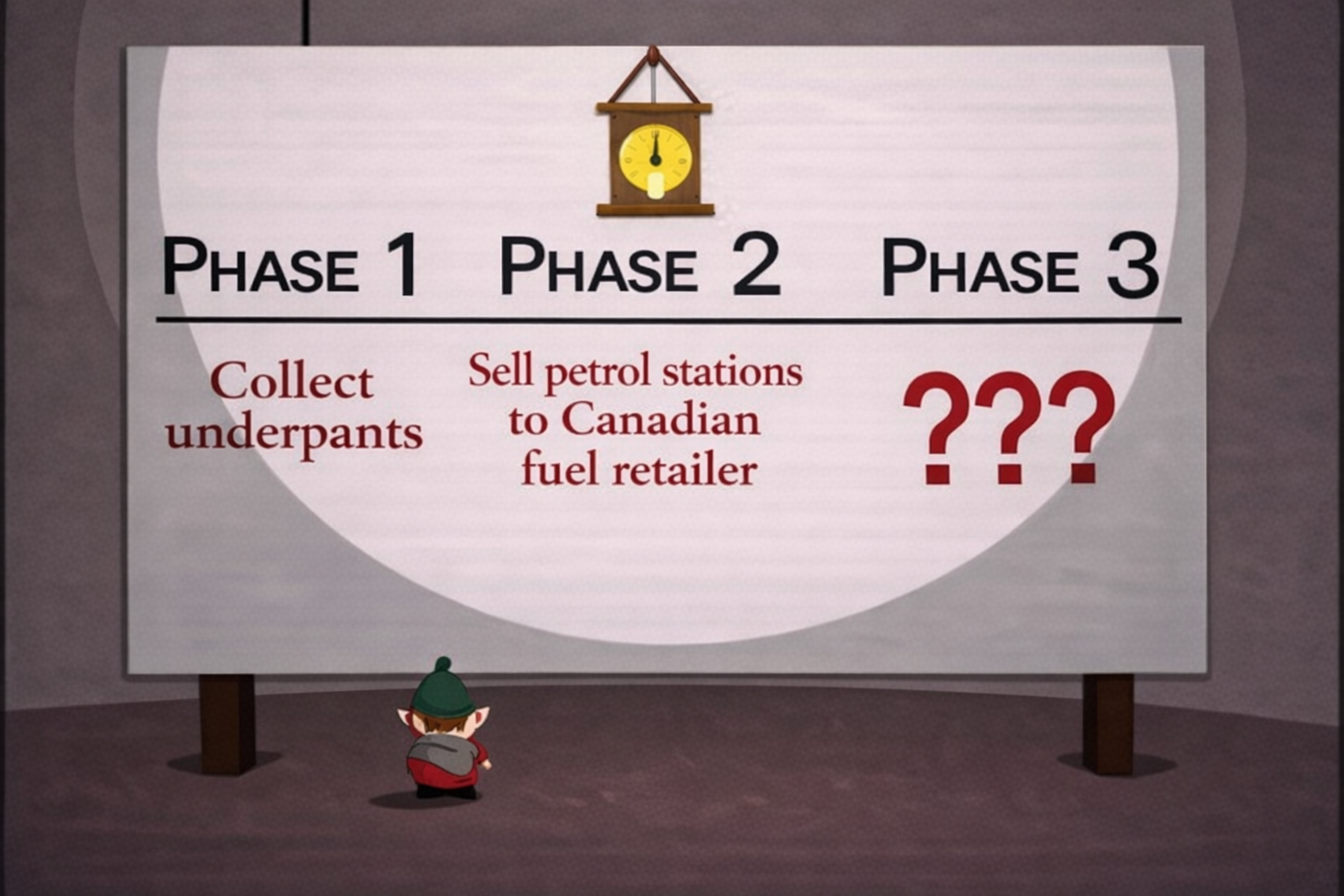
The EV charging industry is moving from its startup phase to its infrastructure phase. The "underpants strategy" — collect underpants, ???, profit — is reaching phase 3 for the survivors, while those stuck in phase 2 are being absorbed or shut down.
The future belongs to companies that own or control attractive property, operate at scale, and have the financial backing to survive the remaining unprofitable years. But the plot twist that nobody fully anticipated is that some of the strongest property owners — the oil majors — would voluntarily hand over the keys. The property advantage is real, but it has changed hands. The winners will be the companies that recognise the value of what they've acquired, and who have the vision and the operational capability to convert petrol stations into charging hubs before the fuel revenue dries up.
For everyone else, the consolidation game has already started — and the best move might be to sell before your negotiating position gets any worse.
If you're a CPO investor, a fuel retailer wondering what to do next, a fuel retail group that just inherited a portfolio of petrol stations, or a property owner trying to figure out the value of your parking lot, I'd love to hear from you. The conversation about who wins this game is far from over.
Appendix: Oil major retail divestments in detail
Company-level breakdown
The three Western supermajors have taken distinctly different approaches to their European retail portfolios since 2022.
BP
has been the most aggressive. It sold its Swiss retail network in 2022, exited Turkey in 2023–2024, agreed in July 2025 to sell its 300 Dutch petrol stations (plus 15 EV charging hubs) to Catom, and initiated the sale of over 260 Austrian retail sites. It is also marketing its Gelsenkirchen refinery and has agreed to sell a 65% stake in Castrol for approximately $6 billion. All of this is part of a $20 billion divestment programme designed to refocus on upstream oil and gas. BP isn't just trimming its retail portfolio — it is systematically exiting company-owned retail across Europe.
TotalEnergies
started even earlier. Since 2015, it has divested its service station networks in Italy, Switzerland, and the UK. In 2023, it sold 100% of its networks in Germany and the Netherlands to Alimentation Couche-Tard — 1,590 stations in total — and formed a joint venture for another 619 stations in Belgium and Luxembourg. The transaction, valued at €3.1 billion, covered the service station networks and B2B fuel card activities. TotalEnergies' rationale was blunt: Fuel-related retail revenues will decline as EVs charge at home and at work, and the company wants to redeploy capital to upstream production and integrated power. It retained its off-station EV charging hubs, hydrogen retail, and wholesale fuel business.
Shell
is the most nuanced. It announced plans to divest around 1,000 company-owned sites globally in 2024–2025 — but that's only about 2% of its ~47,000-location network. And while Shell is exiting non-core markets (including Mexico), it is simultaneously acquiring in the US (Brewer Oil, Timewise) and investing in European charging partnerships (Redevco for 55 German retail parks). Shell is consolidating around core markets, not exiting retail. Of the three Western majors, Shell is the only one still playing the "own the property and add chargers" game at scale in Europe.
Updated 24 March 2026: Revised the oil major section to correct the characterisation of retail divestment buyers (Couche-Tard/Circle K and Catom are dedicated fuel retailers, not convenience retail outsiders). Added COCO/CODO/DODO ownership breakdown for the Couche-Tard–TotalEnergies transaction. Merged the two fuel retailer buyer subsections into one. Moved the detailed oil major company profiles to an appendix to improve readability on mobile.